





Eye For Film >> Movies >> I'm Not Neo (2025) Film Review


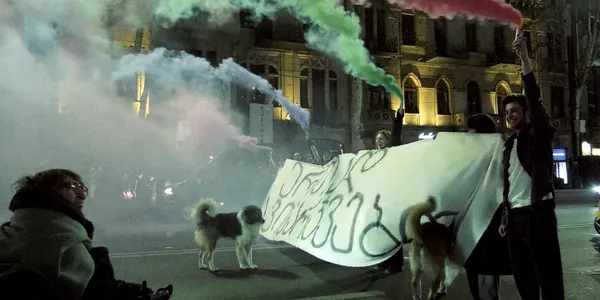

Premiering at the Kutaisi International Short Film Festival, I’m Not Neo is a chief example of contemporary documentary work that tries to record and document in real time the changes that have enveloped the country of Georgia. Following the adoption of the Russian-style ‘foreign agents’ law, anti-government protests have continued in the capital Tblisi for a little over two years. The theatre community, highly active in the movement, has become a target of state repression.
In one of several documentary shorts making up the Cinema and Resistance – The Memory of Protest section of the festival, directors Nika Odishelidze and Amiran Jimsherashvili look closely at students of the Tbilisi Theatre University, who went on strike by camping inside the building and refusing to leave.

Rather than narrate the protest, the directors record its temperature. The film opens outside the Public Broadcasting Building, where students demand live airtime to broadcast their positions. A glass wall splits the frame. Students on one side, police on the other, guarding the so-called People's Television from the people. The camera moves with the crowd - shoulder-height, jostled, breathing on the mic – while focus slips, catches, and then slips again. This isn't technical sloppiness, it's a decision: by never relying on steady camerawork, the film rejects the traditional narrative perspective that hovers above the action. Favouring emotion over exposition and impressively capturing the crowd's spirit, images become so tight they start to feel dizzying. That claustrophobia pulls the viewer into the screen. The framing doesn't represent the protest so much as puts you inside its optics.
Among his fellow students, Temo is the one we follow home for a glimpse of his domestic life, bringing a human dimension to the broader movement. On the street, the boy is rebellious; at home, he's a son whose mother worries his feet will get wet. Shoulder to shoulder with his friends, Temo shares his personal reasons for fighting – a better, freer life for his disabled brother and everyone like him. Although a little heavy-handed, the scene reinforces the emphasis on unity and solidarity. “I’m not Neo,” says Temo – a reference to The Matrix’s chosen one, which he rejects.
Halfway through, a change of scenery occurs. In Guria, Georgia’s western region, students are seen clearing roofs and gathering medicines after a heavy snowfall. It's a clever counterweight, moving from Tbilisi's jittery frames to snow-blanched, boxy compositions. The camera lurks from the neighbouring room, as if testing what solidarity looks like when the element of spectacle recedes into a routine.
Ultimately, the students are fined for their actions and face expulsion, with only sustained public support forcing the administration to back down. I’m Not Neo closes on the University building being vacated after an 80-days occupation. Outside, Temo and his friends are greeted by a chanting crowd, reuniting the student protest with the larger street movement. The final montage is a mix of sounds and flashes, in which no clear resolution is offered because none exists yet. By acknowledging this uncertainty, the film captures the electric atmosphere of Tbilisi’s streets. In an era of endless footage, Odishelidze and Jimsherashvili turn documentary into feeling – a cinema of emotions that must hold the line until history catches up.
Reviewed on: 17 Oct 2025


